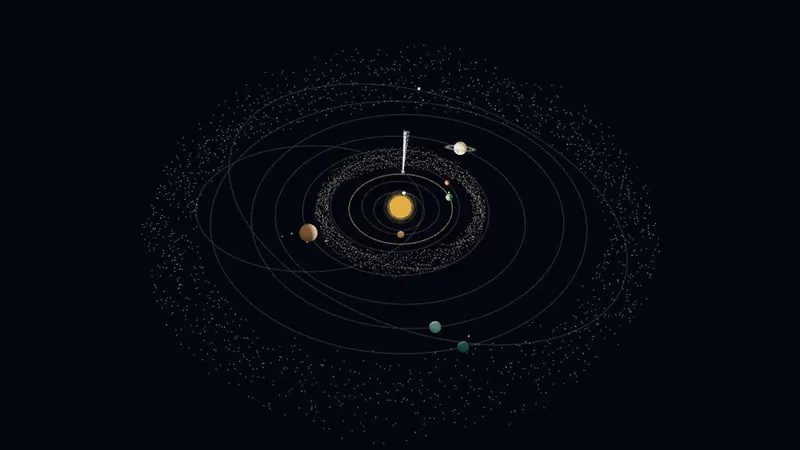
Solar System
Earth
Explore our planet, then compare the other worlds orbiting the Sun.
- Orbit semi-major axis
- One orbit
- Mean radius
- Known moons
More facts
Atmosphere & surface
Rings
Read more at NASA ↗Reading this model
Distance & time
1 AU is about the Earth–Sun distance. The semi-major axis is half the longest diameter of an orbit. Moon distances are measured between body centres. At 1×, an Earth year takes one minute.
Belts & moons
The asteroid belt lies between Mars and Jupiter; the icy Kuiper belt lies beyond Neptune. Dots are enlarged samples of widely spaced objects. Eight representative moons are shown; follow their parent to see the group.
Scale & accuracy
Exaggerated mode is the default: it restores the original diagram’s enlarged bodies, compressed planetary distances and expanded moon systems. Relative sizes and distances are not to scale. Realistic mode puts body sizes and orbital distances on the same scale. Small bodies may be tiny in the overview; use Follow for a close-up. Belt dots, the Sun’s halo and comet gas are illustrative in both modes. Bodies follow fixed elliptical orbits with representative tilts. Starting positions are illustrative, and the comet is fictional. Spin and gravitational interactions are not simulated.
Discover more at NASA ↗